Songwriting
How to Write Song Lyrics: From Your First Idea to a Finished Draft
Learn how to write song lyrics with step-by-step examples. Find an idea, build verses and a chorus, and use AI to help create and revise your first draft.
On this page
- 1. How to Create Song Lyrics from a Simple Idea
- 2. Turn Feelings into Specific Images and Phrases
- 3. Choose a Simple Song Lyrics Structure
- 4. Write a Chorus with a Clear Hook
- 5. Write Verses That Move the Story Forward
- 6. How to Create Your Own Song Lyrics with AI
- 7. Revise Your Lyrics for Meaning, Rhythm, and Singability
- Finish Your First Lyric Draft
- FAQ About Writing Song Lyrics
You have something you want to say, but the moment you try to turn it into a song, the words feel awkward. A sentence that sounded honest in your head suddenly becomes a forced rhyme—or you write a few good lines and have no idea what comes next.
To write song lyrics, start with one clear idea, collect specific details, and organize them into verses and a chorus. Write a rough draft before polishing the rhymes, then read it aloud to find the lines that need work.
You can begin with a notebook, a voice memo, or an AI-assisted draft. What matters is giving the song a clear message and making choices about how to express it.
This guide follows one original teaching example: someone working away from home who misses their family but still wants to build a life of their own. You’ll see how that idea becomes a structure, individual sections, and a complete lyric draft. Later, we’ll use the same idea in MusicGo and compare real generated lines with editorial revisions.
1. How to Create Song Lyrics from a Simple Idea
Start with a moment you can describe. “Homesickness” is a theme; standing outside your apartment after a late shift, listening to a message from your mother, is a scene.
A scene gives you something to write about before you need to worry about sounding poetic. Answer four questions:
- Who is speaking? A young adult who has moved away for work.
- Who are they addressing? Their mother.
- Where are they? Outside their apartment after a late shift.
- What do they want to say? They miss home, but they still want to give their new life a chance.
Turn those answers into a one-sentence brief:
A first-person song about missing home after moving away, with an ending that feels hopeful rather than defeated.
That sentence becomes a useful test. When a line introduces an unrelated idea, ask whether it belongs in this song.
If you don’t have a starting point yet, explore these lyric ideas and suggestions. Choose one idea, then narrow it to a person, a place, and something happening there.
Try it: Complete this sentence before writing a verse:
This song is about ______, told by ______, during the moment when ______.
You don’t need an unusual subject. A familiar experience can become compelling when the details feel specific.
2. Turn Feelings into Specific Images and Phrases
Once you have an idea, write down the evidence of that feeling. Instead of listing “sad,” “lonely,” and “far away,” ask what the person sees, hears, touches, or does.
For our example, that might include a phone lighting up, a bag of groceries, and an apartment with no familiar voices inside. Build a small collection of material:
| Feeling or idea | Detail you could use |
|---|---|
| Missing family | A saved message asking whether you’ve eaten |
| Living somewhere unfamiliar | Checking the street number before turning |
| Trying to be independent | Carrying groceries upstairs after work |
| Wanting reassurance | Holding the phone after the message ends |
| Keeping a connection to home | Knowing the porch light will still be on |
These are possibilities, not lines you must squeeze into the song. Write a paragraph without rhyming:
I get home late and listen to your message outside the door. You ask if I’ve eaten. I’m holding groceries, but I haven’t cooked anything yet. I want to tell you I’m doing well. Mostly, I want to hear your voice again.
Now underline phrases that carry a clear image or emotional tension. “You ask if I’ve eaten” reveals care. “I want to tell you I’m doing well” creates a gap between what the speaker says and what they feel.
Keep your natural vocabulary. If you would say “I almost called,” you don’t need to replace it with a grander phrase just because you’re writing lyrics.
3. Choose a Simple Song Lyrics Structure
A structure helps you decide where each idea belongs. For a first draft, try:
Verse 1 → Chorus → Verse 2 → Chorus → Optional Bridge → Final Chorus
You can leave out the bridge until the rest of the song works.
| Section | Main job | Plan for our example |
|---|---|---|
| Verse 1 | Introduce a situation | Arriving home late and hearing a message |
| Chorus | Express the main feeling | Keep a connection to home while learning to live away |
| Verse 2 | Add movement | The new place is becoming familiar |
| Bridge | Change perspective | Missing home doesn’t have to mean giving up |
| Final chorus | Return with added meaning | The speaker still misses home but feels more settled |
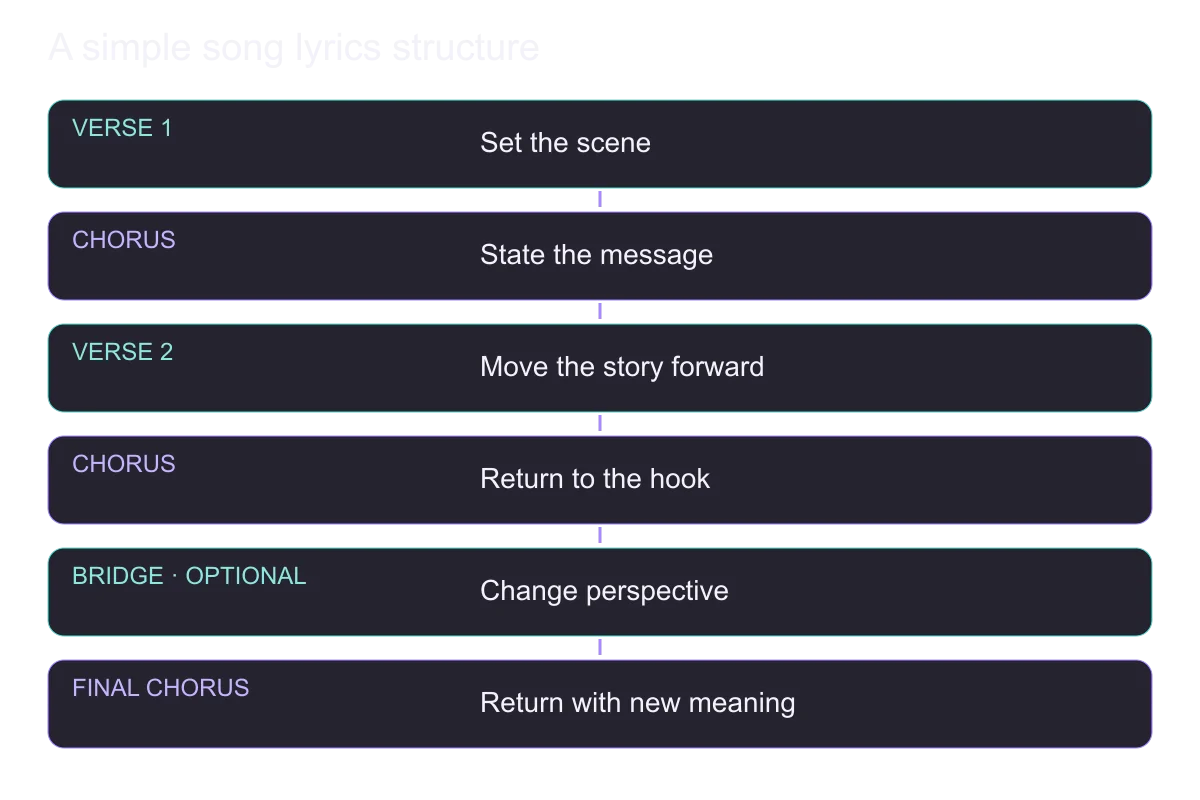
A simple structure gives each section a different job.
A verse often benefits from details and actions. A chorus usually gives those details their emotional meaning. “My phone lights up outside the door” belongs naturally in a verse. “Leave the porch light on” could become a chorus hook because it expresses the larger need for connection.
You don’t need a pre-chorus, a bridge, or a fixed number of lines to make a valid song. Use the sections that help the idea unfold.
4. Write a Chorus with a Clear Hook
The chorus should make the song’s central message easy to understand and remember. For this example, “Leave the porch light on” gives the speaker a simple request. It also provides a concrete image for something harder to say: “I want to know I still have a place with you.”
Here’s an original teaching draft:
Leave the porch light on
Though I won’t be home tonight
I’m learning how to live out here
One late bus at a time
When you call, I hear the kitchen
And the radio turned low
Leave the porch light on
There’s still a little way to go
The opening phrase returns near the end, giving the chorus a recognizable center. The kitchen and radio connect the request to a remembered place.
This is a lyric draft. When you eventually add a melody, you may need shorter lines, repeated words, or a different placement of the hook.
- State the main message in ordinary language.
- Find a short phrase or image that can carry it.
- Build a few lines around that phrase.
- Repeat it where it feels natural.
- Read the chorus without the verses. Can you still understand the main feeling?
If the chorus contains several competing messages, save one for another song. A clear emotional center gives the verses something to support.
5. Write Verses That Move the Story Forward
With a chorus in place, write verses that show why the speaker needs to say it. Our first verse introduces the late-night situation:
My phone lights up outside the door
Your message asks if I’ve been fed
I set the groceries on the floor
And hear the rest beside my bed
There are ordinary actions here: receiving a message, putting down groceries, listening. The chorus can then express what those actions mean.
For the second verse, something needs to change. Repeating the same lonely scene in different words would give the listener little new information. Try showing small signs of adjustment:
I know the driver on my route
I’ve learned which shops stay open late
Tonight I take the long way back
And call before it gets too late
The speaker is still away from home, but the new place is becoming more familiar. Calling home now feels like a choice they can make, rather than something they can only wish for.
Choose meaning before a perfect rhyme. A rhyme can connect lines, create expectation, or make a phrase satisfying to sing. It becomes a problem when it makes the speaker say something unnatural.
Compare:
My lonely heart is full of fright
Beneath the city’s silver light
with:
I almost call you from the stairs
Then stand a minute with the phone
The second example doesn’t provide an obvious end rhyme, but it gives the singer a specific action. You can work on sound and rhythm once the meaning is right.
If you want an easy pattern to try, rhyme the second and fourth lines of a four-line verse. Treat that pattern as a writing aid, and change it when a better line needs room.
6. How to Create Your Own Song Lyrics with AI
AI can help when you have a story but struggle to turn it into a draft. The material you collected earlier gives the tool direction—and gives you a basis for deciding whether the result fits.
MusicGo’s AI lyrics generator lets you describe your idea and request a verse, chorus, or complete lyric structure. You can include genre, mood, language, rhyme, and section instructions in the same description.
It generates lyrics as text. You can open the completed work, copy the result, and revise it in your own writing app.
Give the generator a useful brief. “Write a sad song” leaves most of the creative decisions unspecified. A more detailed description gives the draft a person, a situation, and an emotional direction.
We used the following brief in MusicGo to generate the draft discussed below:
Write English lyrics for a reflective acoustic pop song. The narrator has moved away for their first job and is speaking to their mother. Begin outside their apartment after a late shift, listening to a message asking whether they have eaten.
Use two four-line verses, a repeatable chorus, and a short bridge. Build the chorus around “Leave the porch light on.” Let the second verse show small signs that the new city is becoming familiar.
Use conversational language and concrete details. Keep the mood homesick but increasingly hopeful. Prefer natural meaning over forced rhymes. Avoid grand declarations and familiar phrases such as “broken wings” or “lost in the dark”.
Create and review your draft in four steps:
- Open the MusicGo AI lyrics generator.
- Enter your story and creative instructions in the description. The page accepts up to 3,000 characters.
- Review the displayed credit cost and generate your lyrics.
- Open the completed work, copy the text, and edit it in your own editor.
From a generated draft to a more personal lyric
MusicGo returned a draft titled Porch Light Message. The first verse kept the late-shift scene and the mother’s message:
Outside my apartment, keys in my hand
Late shift dust on my shoes and sleeves
Your message lights up the cracked screen glass
Asking if I ate, and if I’m getting sleep
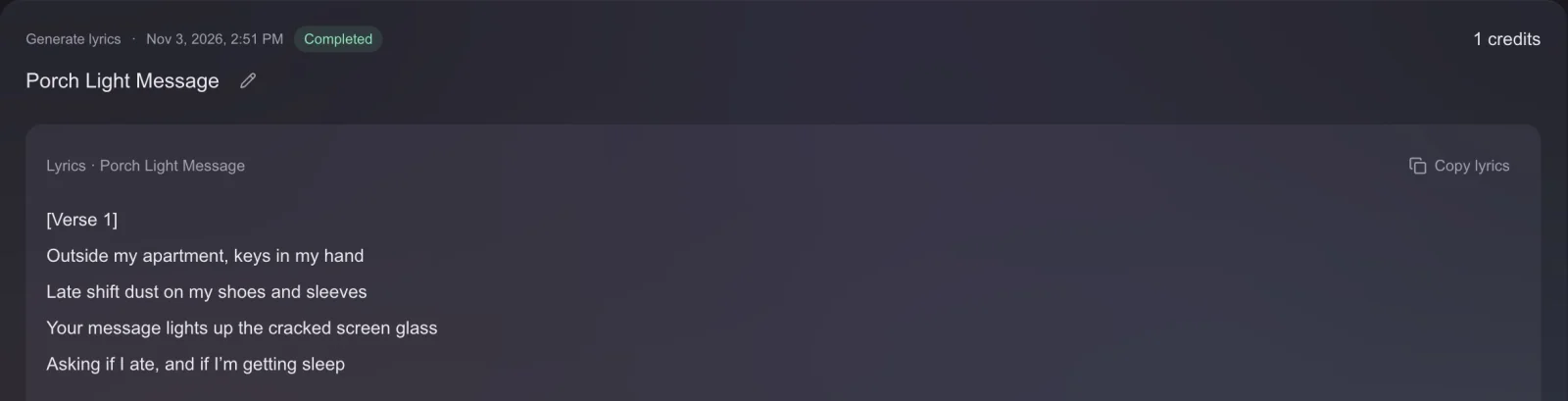
An excerpt from the generated draft, before editorial revision.
The second verse introduced familiar places in the new city, including a train and a corner store. Those details gave us something concrete to build on. A few other lines needed closer attention:
| MusicGo’s generated wording | Our editorial revision | What changes |
|---|---|---|
| And the corner store man nods my name | The corner shop owner knows my name | A more natural expression of growing familiarity. |
| I’ll be there, I’ll be there, come dawn | I’ll call you when my shift is done | A connection that fits living away, replacing an unexpected promise to return by morning. |
| And that’s enough to carry me straight | It helps me face another day | A more direct meaning for the bridge. |
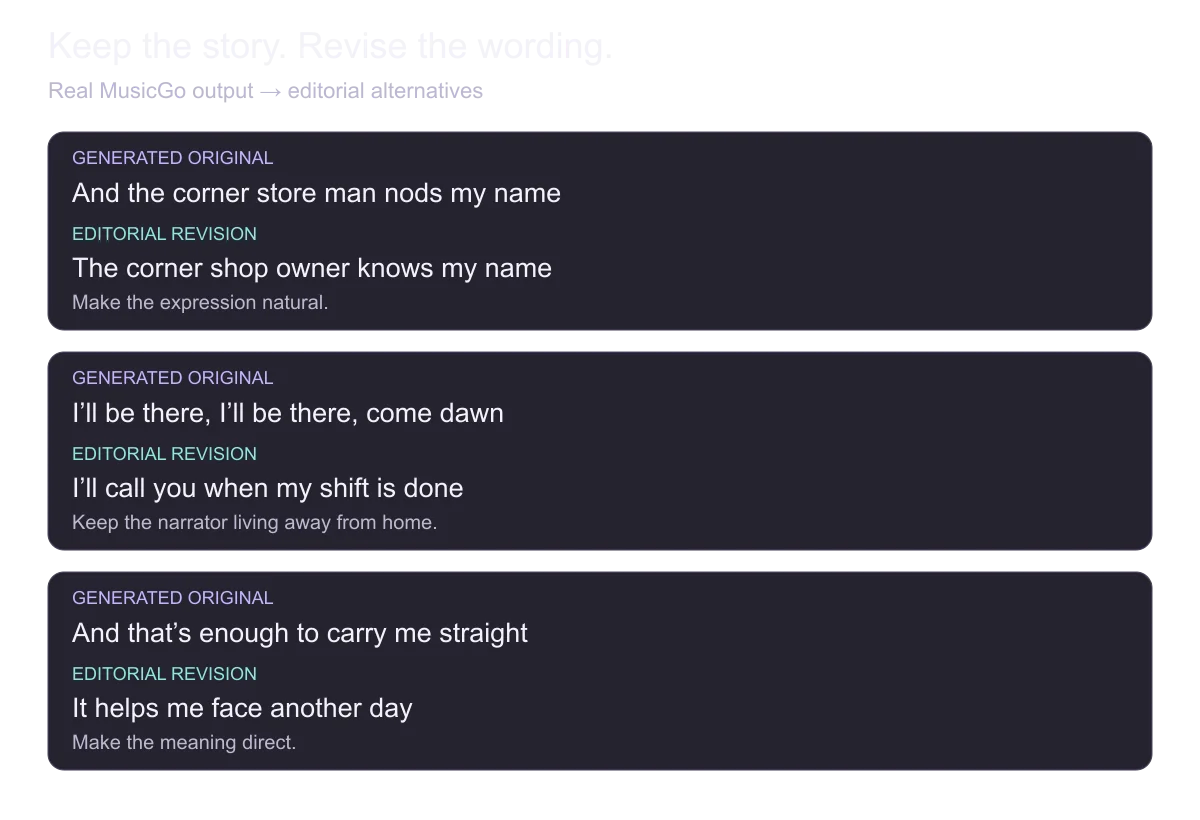
Generated lines paired with editorial alternatives.
The revisions are editorial alternatives, not a second generated result. Try the same process with your draft: keep the details that serve your story, replace awkward expressions, and check whether the chorus promises something the verses never establish.
If you request another generated draft, it is a new credit-consuming request. A detailed prompt can guide the result, but you still need to check whether the structure, rhythm, and wording work.
7. Revise Your Lyrics for Meaning, Rhythm, and Singability
Once you have a full draft, read it aloud from beginning to end. Tap a steady pulse as you speak if that helps you hear the phrasing. Listen for places where you rush, hesitate, or stress a word unnaturally.
Make one editing pass at a time:
| Editing pass | What to check |
|---|---|
| Meaning | Does every section support the central idea? |
| Story | Does verse two add a change, detail, or discovery? |
| Voice | Does the speaker use believable, consistent language? |
| Rhythm | Can you deliver the lines without cramming in words? |
| Sound | Do rhymes and repeated sounds feel natural? |
| Hook | Is the chorus recognizable when it returns? |
For example, “I am experiencing loneliness tonight” could become “I eat beside the kitchen sink.” “I desperately wish to hear your voice” could become “I play your message one more time.” Both revisions replace a broad statement with an action.
Returning to our original teaching draft, we can also change “I know the driver on my route” to “The driver knows my stop by now.” That shows familiarity from another person’s perspective. Replacing the repeated “late” ending in verse two clarifies the timing.
Read the complete teaching example. Here’s the assembled draft, titled Leave the Porch Light On. This is the editorial teaching example developed throughout the guide, separate from MusicGo’s generated draft.
Verse 1
My phone lights up outside the door
Your message asks if I’ve been fed
I set the groceries on the floor
And hear the rest beside my bed
Chorus
Leave the porch light on
Though I won’t be home tonight
I’m learning how to live out here
One late bus at a time
When you call, I hear the kitchen
And the radio turned low
Leave the porch light on
There’s still a little way to go
Verse 2
The driver knows my stop by now
I’ve learned which shops stay open late
I take the long way home from work
And call before you go to bed
Repeat chorus
Bridge
You ask me if I’m coming back
I say, “I’m coming for a while”
I mark the weekend on the fridge
And stay there smiling at the date
Final chorus
Repeat the chorus. You can try replacing its last line with “I’ll be home before you know” to turn the ending toward the planned visit. Keep the original ending if you want the song to remain more open.
Record a rough spoken voice memo and listen without reading. Mark anything confusing or difficult to deliver, then revise those places first. Reading aloud helps with phrasing; the final fit will still depend on the melody you eventually choose.
Finish Your First Lyric Draft
Choose one moment you can describe clearly. Write down what happens, what the speaker wants, and what changes by the end. Give yourself a full draft to revise before trying to perfect every line.
If you’re stuck between your idea and the first page, bring your story and details to MusicGo, generate a starting point, and shape the lines into something you want to sing.
Create your first lyric draft with MusicGo
FAQ About Writing Song Lyrics
How do you write song lyrics if you’re a beginner?
Start with one scene and one message. Describe the scene in a short verse, then write a chorus that expresses what it means to the speaker. Finish that small version before adding a second verse or bridge.
Do song lyrics have to rhyme?
No. Lyrics can use repetition, rhythm, internal sounds, and phrasing without regular end rhymes. If you do use rhyme, keep the meaning and natural word order intact.
Should you write lyrics or melody first?
Either approach can work. Starting with lyrics helps you develop the story and message. Starting with a melody gives you a pattern of stresses and syllables to write into. When you already have a tune, sing each line as you write so the words fit the phrase.
How can you make AI-generated lyrics sound more personal?
Give the draft details from your own experience, then revise it line by line. Replace broad statements with specific actions, remove phrases you wouldn’t use, and check that each section says something you mean. Read or sing the result aloud to hear where it still feels unfamiliar.