Songwriting
20 Lyric Ideas and Lyric Suggestions to Try With AI
Explore 20 lyric ideas, get practical lyric suggestions, and learn how to write AI prompts that turn a theme into verses, hooks, and choruses with MusicGo.
On this page
- 20 Lyric Ideas for Your Next Song
- How to Turn Lyric Ideas Into AI Prompts
- Better Lyric Suggestions Start With Specific Prompts
- Prompt Examples for Verses, Choruses, and Hooks
- How to Generate a Lyric Draft With MusicGo
- How to Refine AI Lyric Suggestions
- Choose One Idea and Start Your Draft
- FAQ: Lyric Ideas and AI Suggestions
You know the feeling you want to write about. Finding the words is harder.
Useful lyric ideas often begin with something smaller than a big emotion: a cup left in the cupboard, a familiar street that looks different, or a message you keep rewriting. Give that detail a narrator and something unresolved, and you have a starting point for a song.
To get more focused lyric suggestions from AI, describe the scene, who is speaking, how the emotion changes, and which part of the song you need. “Write a sad song” leaves almost everything open. “Write a first-person verse about setting the table for someone who no longer lives here” gives the draft a direction.
Choose an idea below, then use the prompt examples to develop it.
20 Lyric Ideas for Your Next Song
You do not need a complete story before you start writing. Choose a moment that raises a question, then explore what the narrator wants, remembers, or cannot say.
Love, distance, and things left unsaid
- A message that stays in drafts. Someone keeps editing a text after an argument. Each version reveals something they are afraid to admit. Build the chorus around the difference between being right and being understood.
- Two people on different schedules. One comes home as the other leaves. Tell the relationship through notes, reheated dinners, and a hallway light. Let affection and exhaustion exist together.
- An extra cup on the table. Someone keeps preparing breakfast for two after a separation. Stay with the habit rather than explaining the whole breakup.
- The first ordinary day together. Skip the dramatic first kiss. Write about buying groceries or missing a bus—and realizing ordinary life feels different with this person.
Growing up and changing direction
- An old photo inside a moving box. Packing to leave home brings an earlier version of the narrator into view. Let the verse remember who they were and the chorus consider who they might become.
- The job you thought you wanted. A name badge or office key represents a dream that no longer fits. Explore the tension between looking successful and feeling misplaced.
- Learning to enjoy your own company. Begin with an uncomfortable dinner alone. End with a small choice that shows solitude becoming welcome.
- A promise made at seventeen. Revisit an ambitious plan years later. Decide whether the song mourns the promise, laughs at it, or finds a new way to keep it.
Home, memory, and belonging
- Your hometown without you. A favorite shop has closed, but the road still bends in the same place. Ask whether home is a location, a person, or a remembered version of yourself.
- A family recipe with missing instructions. A handwritten recipe leaves out the part everyone was supposed to know. Use cooking to explore inheritance, distance, or affection.
- The last bus after a long shift. Follow one person through a quiet journey home. Use the window, tired hands, and passing lights to suggest a larger life.
- A childhood bedroom turned into storage. Someone returns to find boxes where their bed used to be. Let the room show how the family has changed.
Loss, regret, and repair
- An apology that arrives late. Write from someone who finally understands the harm they caused. Leave room for the other person to decline forgiveness.
- A voice you remember imperfectly. The narrator can recall a laugh but struggles to remember an ordinary sentence. Focus on one sound or habit rather than summarizing the relationship.
- The object you cannot throw away. A cracked mug, spare key, or concert wristband becomes a reason to revisit unfinished feelings.
- Missing someone you chose to leave. Hold two truths together: leaving was necessary, and the relationship still mattered. The chorus does not have to resolve that tension.
Hope and small acts of courage
- Answering the phone again. After withdrawing from friends, someone finally picks up. Keep the turning point small enough to feel believable.
- A neighbor who notices. Someone quietly clears a path or leaves food at the door. Tell a hopeful story through actions.
- Starting over without announcing it. A person takes one practical step toward a different life. The drama is in doing it before they feel ready.
- Making plans beyond this week. A calendar entry becomes a sign of renewed hope. Let the final image point forward without claiming everything is fixed.
Choose the idea that brings a real detail to mind. Replace the suggested object, setting, or relationship with something you know. That detail gives you a clearer basis for choosing which generated lines to keep.
How to Turn Lyric Ideas Into AI Prompts
A useful prompt works like a short creative brief. It tells the lyric writer what matters while leaving room for unexpected language.
Try this formula:
Write song section in language about specific scene. Use narrative perspective and a genre or lyrical approach. Move from starting emotion toward ending emotion. Include two concrete details. Follow simple structure. Avoid unwanted phrases or approach.
You do not need every element in every request. Start with the scene, perspective, and section. Add constraints when they serve the song.
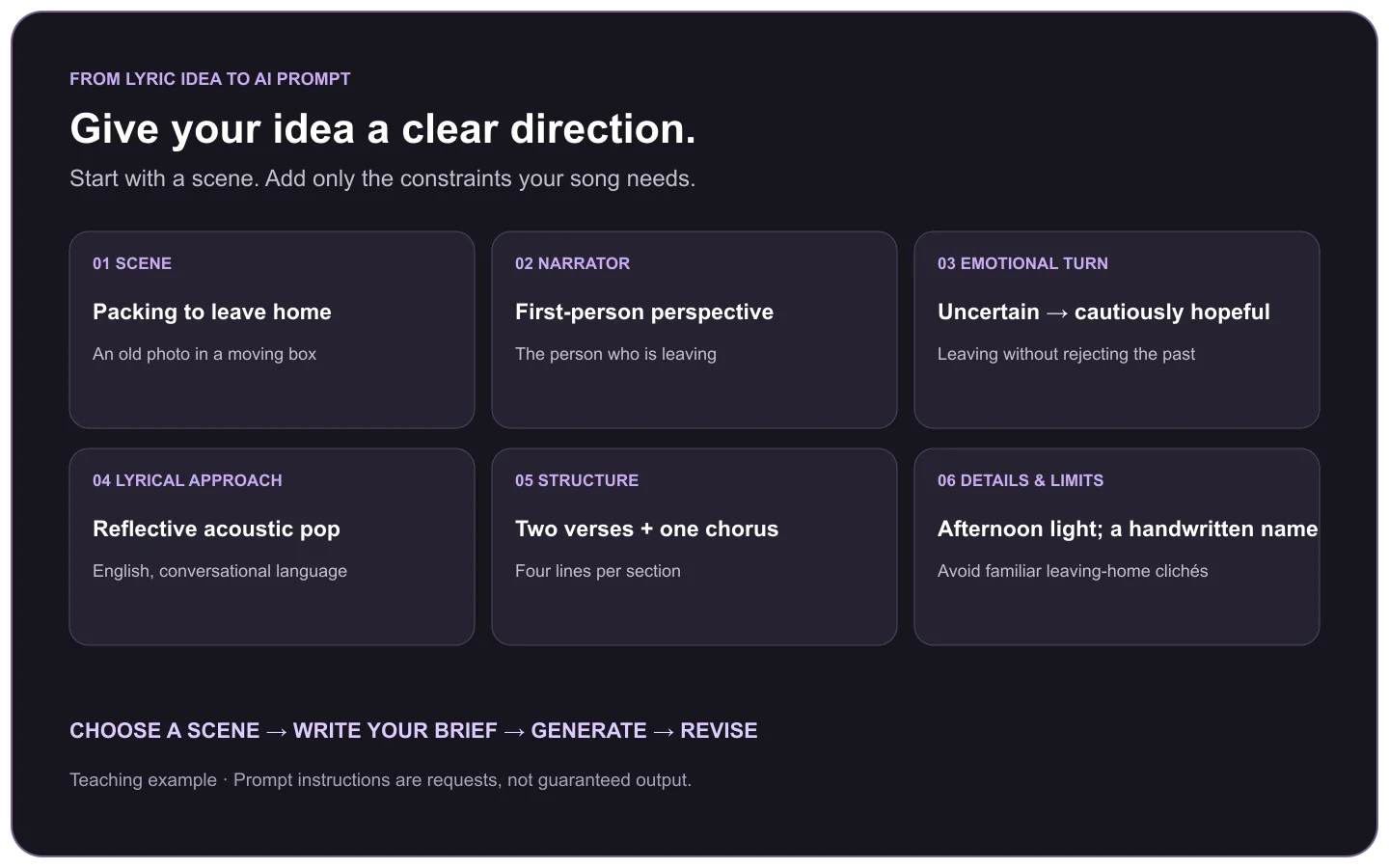
Here is a prompt built from the moving-box idea:
Write two four-line verses and a four-line chorus in English for a reflective acoustic pop song. The narrator is packing to leave their childhood home and finds an old photograph inside a moving box. Use first person. Include a strip of afternoon light and a name written on the back of the photo. Let the verses feel uncertain and the chorus feel cautiously hopeful. Use conversational language. Avoid “spread my wings” and “a brand-new chapter.” Keep the chorus focused on leaving without rejecting the past.
Try this description in the MusicGo AI lyrics generator, replacing the details with your own.
Concrete images give you something specific to develop. Start with an object, place, or person, then describe what the narrator sees, hears, or does before explaining how they feel.
Better Lyric Suggestions Start With Specific Prompts
When a request leaves the story open, the draft may take a direction you did not intend. These six examples show how to give it a clearer brief.
1. Give a broad emotion a scene
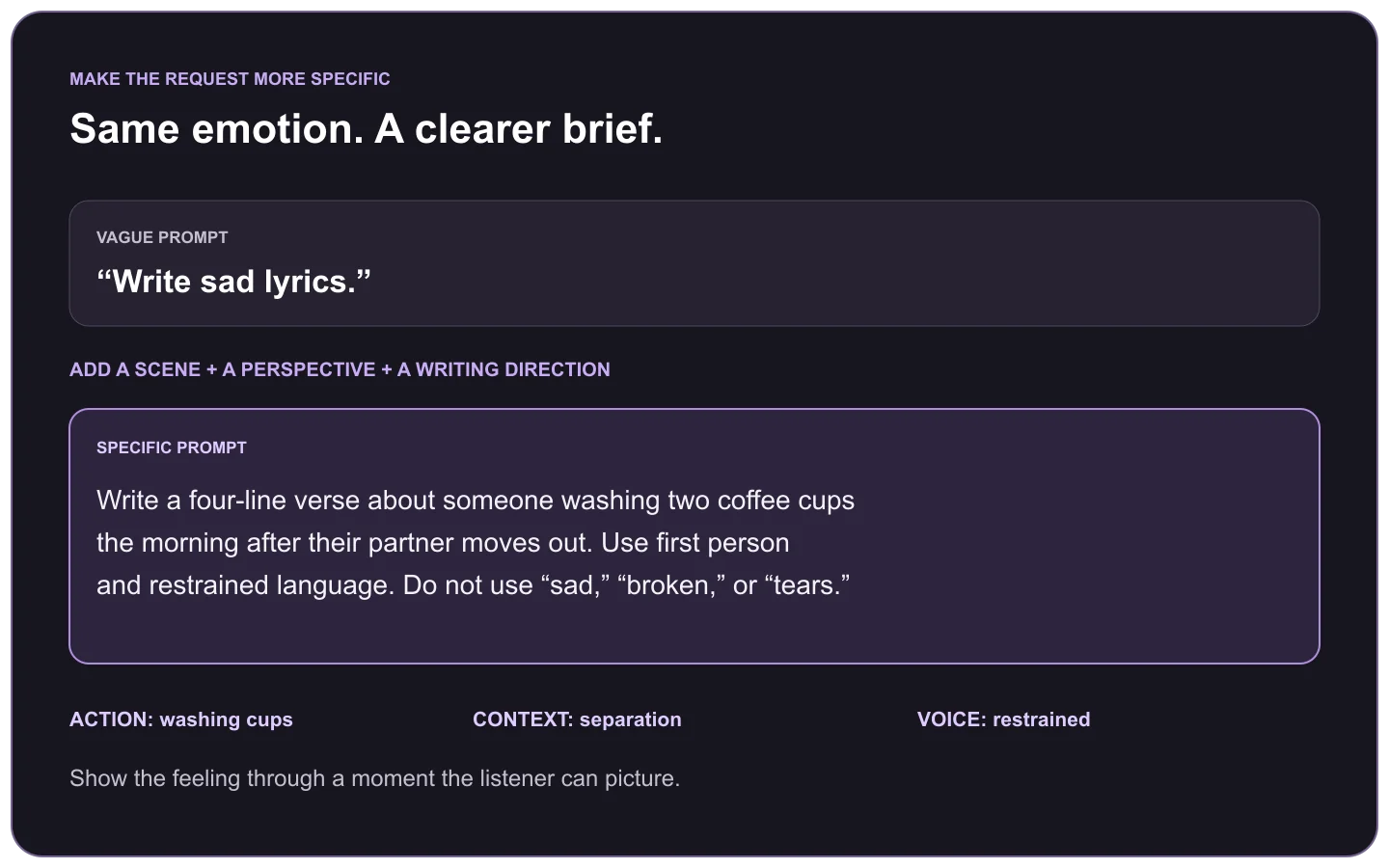
Vague: “Write sad lyrics.”
More specific:
Write a four-line verse about someone washing two coffee cups the morning after their partner moves out. Use first person and restrained language. Do not use the words “sad,” “broken,” or “tears.”
The task now has an action and a setting. The emotion can emerge through what the narrator does.
2. Give a love song a distinctive relationship
Vague: “Write a romantic chorus.”
More specific:
Write a four-line chorus about a couple who work opposite shifts and communicate through notes on the fridge. Make it affectionate but tired, with one short phrase that could be repeated.
The relationship now has a recognizable tension.
3. Give a rap verse a subject and movement
Vague: “Write a motivational rap.”
More specific:
Write an eight-line rap verse about taking the last bus home after a late shift while saving for a recording session. Include internal rhymes where natural. Move from frustration toward determination. Avoid luxury-brand references.
Genre alone does not supply a story. The situation gives the narrator something to respond to.
4. Explain what the chorus should mean
Vague: “Write a catchy chorus.”
More specific:
Write a short chorus about missing a hometown that has changed. Center it on the idea that a place can stay familiar while no longer feeling like home. Use direct language and leave space for repetition.
“Catchy” is a goal. A central idea gives the writer a way to pursue it.
5. Prioritize meaning when requesting rhyme
Vague: “Make every line rhyme.”
More specific:
Write a four-line verse with an ABAB rhyme pattern about returning a spare key. Keep the language conversational. Use near rhymes if exact rhymes would make the meaning awkward.
Treat the pattern as a starting constraint. Check whether the result follows it and whether the language still feels natural.
6. Define an emotional turn
Vague: “Write hopeful lyrics.”
More specific:
Write a verse and chorus about someone answering a friend’s call after weeks of avoiding everyone. Begin with hesitation. Let the chorus show willingness to reconnect without suggesting that every problem is solved.
A change in feeling gives the sections different jobs.
Prompt Examples for Verses, Choruses, and Hooks
Ask for the part you need. A full song draft can be distracting when you are trying to solve one section.
For a verse: develop the scene
Write one eight-line verse in English about returning to a childhood bedroom that is now used for storage. Use first person. Include a faded rectangle on the wall and a box labeled with the narrator’s name. Let the details suggest distance without explaining the emotion directly.
A verse can introduce events, observations, or information that moves the story forward.
For a chorus: focus the message
Write a four-line chorus for a song about learning to enjoy living alone. The central message is that quiet is starting to feel comfortable. Use simple, singable language and one repeatable phrase. Avoid treating independence as proof that relationships do not matter.
A chorus can return to the main feeling while the verses explore different aspects of it.
For a hook: narrow the task
Write a four-line chorus about starting over quietly. Build it around a short repeated hook expressing that change can happen before anyone notices. Avoid “new beginnings,” “rise above,” and “chasing dreams.”
A hook is a memorable element that may sit inside a chorus. Requesting it within a defined section keeps the task connected to a lyric draft.
These prompts are teaching examples. Adjust their length, tone, and details to suit your song.
How to Generate a Lyric Draft With MusicGo
MusicGo accepts a written description of the lyrics you want. Its lyrics tool produces text; music and vocals belong to a separate song-generation workflow.
You can describe the story and perspective, request a verse or complete structure, and include language, genre, rhyme, or mood instructions in the same input.
- Open MusicGo’s AI lyrics generator. Use the Generate lyrics input to describe your idea.
- Enter your creative brief. The description supports up to 3,000 characters. Include the section you need, a clear scene, and important wording or structure requirements.
- Check the credit cost and submit. The page lists one set of lyrics at one credit per request. Check the displayed cost before generating.
- Open the completed work. Generated lyrics are saved to My works. Copy the text into your own editor and revise it there.
Read the draft aloud before deciding what to keep. To request another generated version, submit a revised description. That creates a new credit-consuming request.
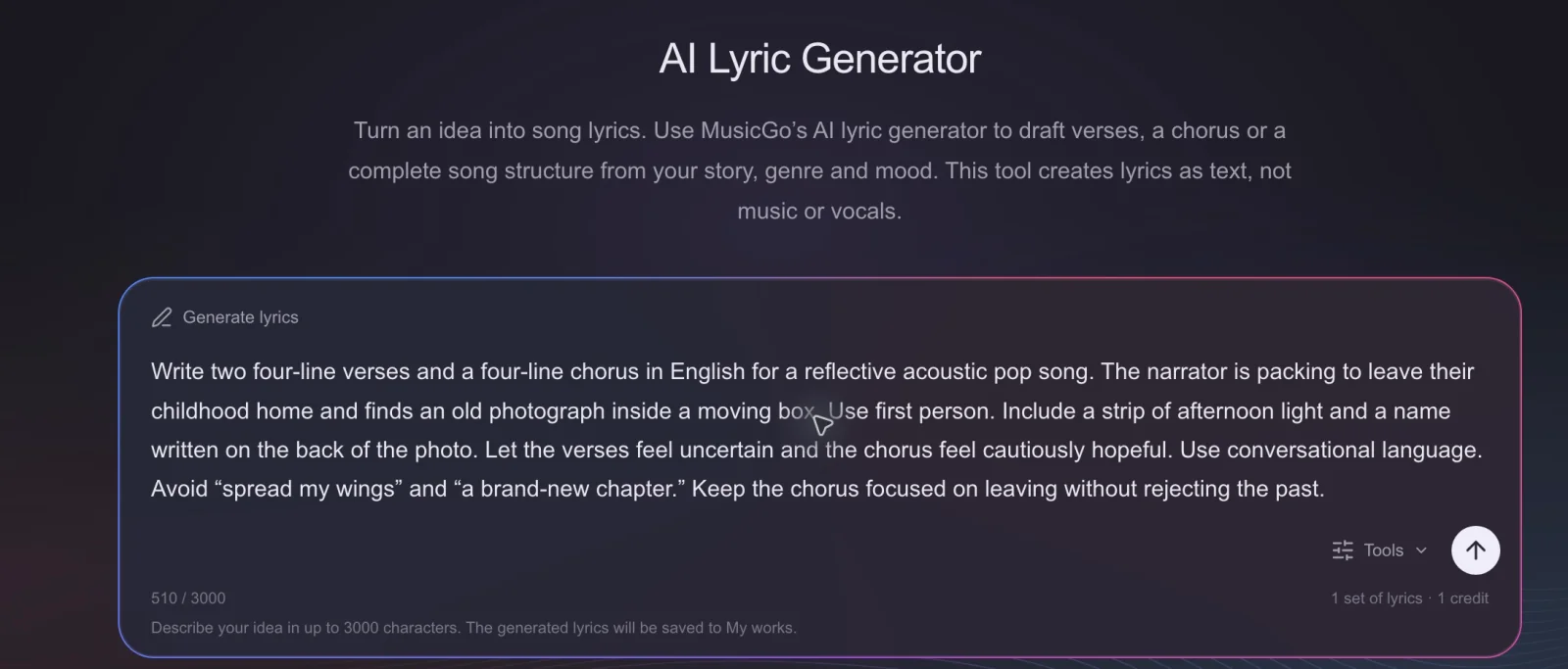
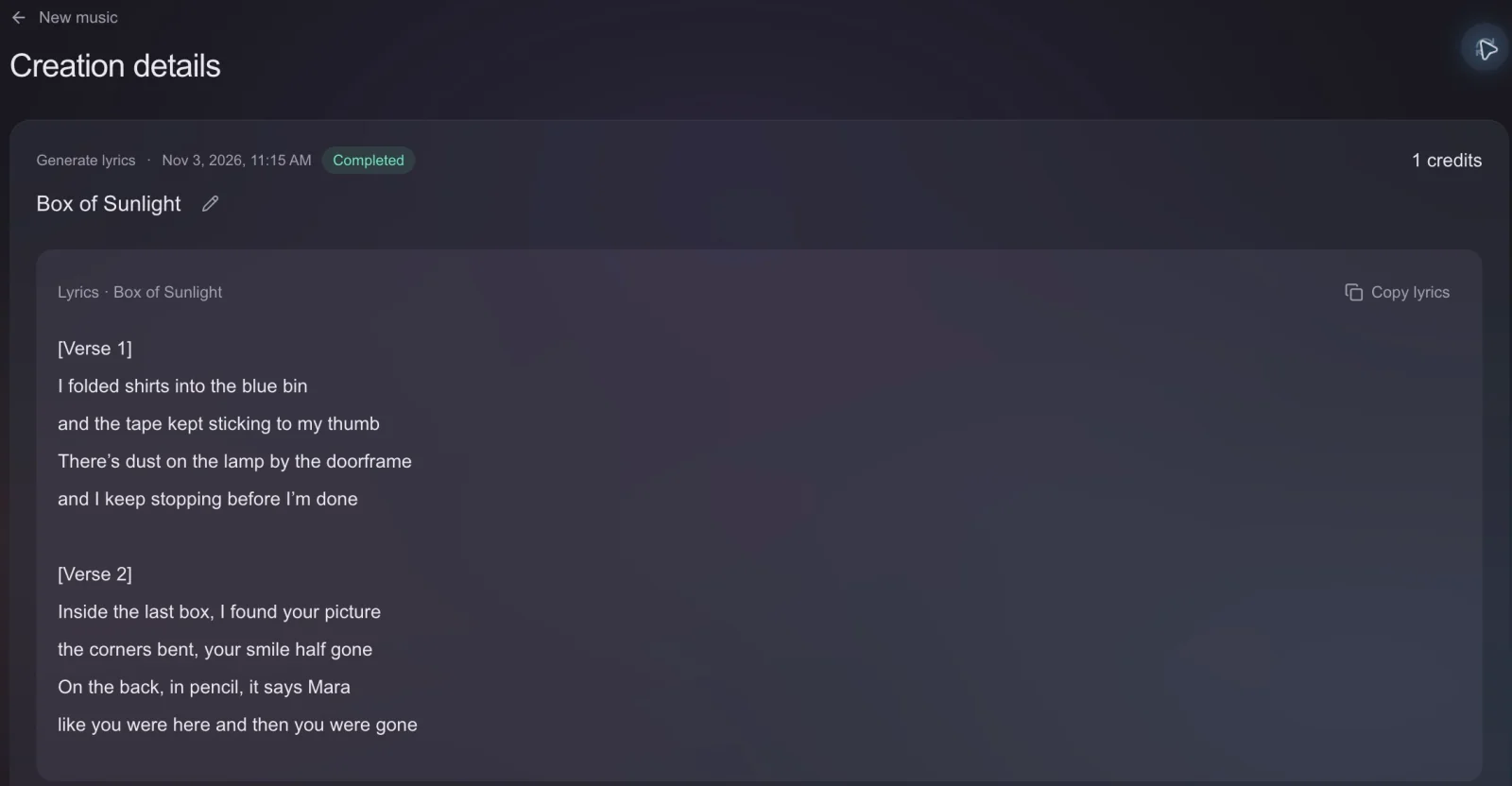
The example prompt above produced a draft titled “Box of Sunlight.” It returned two four-line verses and a four-line chorus. The draft still needs editing: the requested strip of afternoon light did not appear in the lyrics. Read the result against your brief before deciding what to keep.
How to Refine AI Lyric Suggestions
Judge a draft against your intention, not simply whether it rhymes. A smooth line can still tell the wrong story.
If the language feels generic: replace an abstract feeling with an observable action. Instead of saying the narrator misses someone, show the habit that remains. For another generation, specify the object, setting, or gesture you want developed.
If every section repeats the same message: give each section a role. One verse might show the old routine, another the changed situation, and the chorus the narrator’s response.
If the rhyme sounds forced: rewrite the sentence in ordinary speech first. Then consider whether the rhyme word is worth keeping. You can also relax the pattern in a new prompt.
If the lines are difficult to sing: try them against your melody or a simple pulse. Notice crowded phrases, awkward emphasis, and places where you need to breathe. Shorten or rearrange the words.
If the perspective shifts: check who “I,” “you,” and “they” refer to. Remove details the narrator could not know unless the change is intentional.
Keep the strongest line if the rest does not work. A draft can be useful without becoming the finished song.
Choose One Idea and Start Your Draft
Pick one scene, add two details from your own experience, and decide which section to write first. You do not need to settle the whole song before beginning.
When your brief is ready, turn your lyric ideas into a draft with MusicGo. Keep the lines that fit your voice, rewrite the ones that do not, and test them aloud.
FAQ: Lyric Ideas and AI Suggestions
How do I come up with lyric ideas?
Start with a specific moment, object, or unresolved conversation. Ask who is speaking, what they want, and what changes. A familiar subject can take a different direction when you give it a personal detail or an unexpected perspective.
How can I get more personal lyric suggestions from AI?
Include details that matter to your version of the story: a place, an ordinary habit, a particular object, or something left unsaid. Explain the narrator’s attitude toward those details, then edit the draft into language you would use.
Do song lyrics have to rhyme?
No. Rhyme is one writing choice. Repetition, phrasing, imagery, and musical delivery can also connect lines. If a rhyme distorts the meaning, change it or leave it out.
Can MusicGo generate only a chorus or a verse?
Yes. Describe the section you want in the prompt rather than requesting a complete song. You can suggest a line count and rhyme pattern, then check whether the result follows them.
What should I do if the generated lyrics are too generic?
Identify what is missing before generating again. Give the narrator a clearer situation, add concrete details, or name phrases to avoid. Revise the existing draft manually when only a few lines need work.
Ready to take your lyrics further? Once you have revised your draft, create a song with MusicGo. Bring your lyrics into the music-creation workflow and explore a musical direction for them. Song generation is a separate request with its own credit cost.